
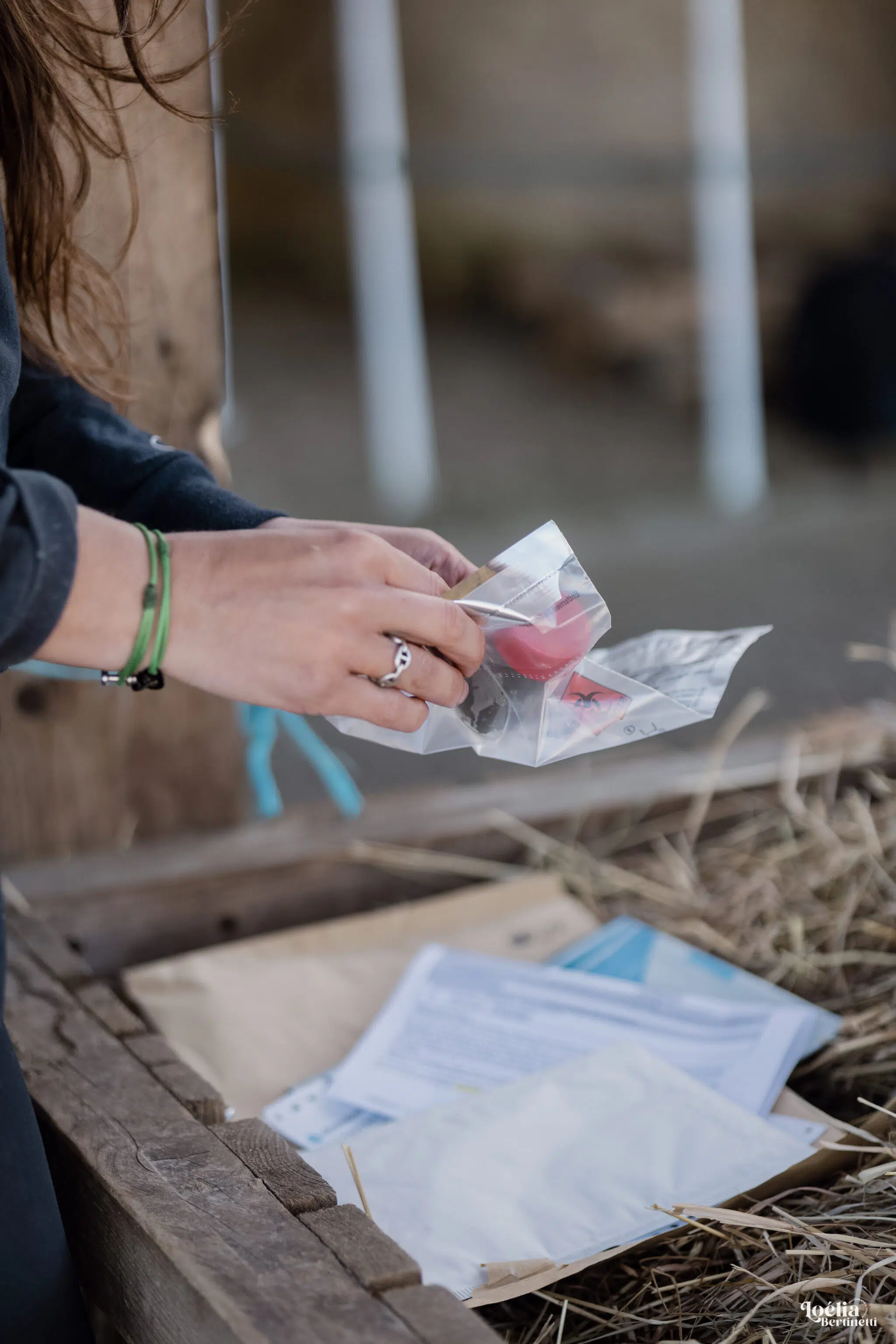
The horse's coproscopy in brief: Coproscopy (or equine coprology) is a microscopic analysis of the crottins for counting pest eggs per gram (OPG). This essential examination of reasoned vermifugation allows us to:
- Identify the types of parasites present (trongles, ascaris, etc.).
- Measure the actual parasitic load to avoid unnecessary treatments.
- Detect horses « strong excretors » that contaminate the pastures.
- Reduce the appearance of resistance to chemical deworming.
Introduction
You've been defusing your horse for years, on fixed dates, without really knowing if he needs it. You are not alone: this is the daily life of most equine owners. Yet there is a simple, fast and inexpensive examination that changes everything : the coproscopy of the horse.
This diagnostic tool makes it possible to know precisely the parasitic load of your horse, to decide knowingly whether to treat it or not and to choose the most suitable molecule.
No more blind vermifugation. In this article, you will know exactly how a coproscopy works, when to achieve it, how to correctly collect and especially how to interpret the results to make the right decisions.
What is coproscopy in horses?
Coproscopy (or coproscopy) is a microscopic analysis of crottins which allows to count the eggs of digestive parasites present in the feces of your horse. In concrete terms, a sample of fresh crottin is taken, mixed with a flotation solution that separates the eggs from the fecal matter, and then observed under a microscope using a small counting grid. The result is expressed in OPG : Eggs By Gramma of crottin.
This analysis is both qualitative and quantitative.
- Qualitative analysis identifies the types of parasites present: strongles, ascaris, tenias, strongyloids, coccidia. Some parasites should never be present in a healthy horse: their detection requires targeted treatment.
- Quantitative analysis, for its part, counts the number of strongle eggs to assess the parasitic load. The higher the OPG figure, the greater the amount of adult parasites present in the digestive tract.
What coproscopy allows is know the actual parasitic status of your horse at an instant T. It is therefore not an estimate based on its appearance, nor an assumption based on the season, but an objective and measurable data that allows you to decide whether or not to defuse your horse with full knowledge of the cause.
Why do a coproscopy instead of systematically deworming?
The systematic vermifugation of the horse (i.e. four treatments per year for all horses, regardless of their parasitic load) is a practice inherited from the 1970s-1980s that is now becoming counterproductive. There are three main reasons for a reasoned approach based on coproscopy.
- First, blind vermifugation promotes parasitic resistance. Treating a horse that does not need deworming unnecessarily exposes parasites to molecules, accelerating the selection of resistant worms. This phenomenon is documented: in France, resistance to benzimidazoles is detected in more than 50% of farms tested.
- Then, Coproscopy can only treat horses that actually need it. In a group of horses, 20% of individuals house 80% of the total parasitic load. Treating all horses systematically amounts to wasting treatment on 80% of them who do not need it.
- Finally, It's the current recommendation of equine veterinarians. IFCE, ESCCAP and parasitic surveillance networks all advocate targeted vermifugation based on individual coproscopic analysis. Coproscopy is not an examination reserved for professional breeding, it is the basic tool of any owner who wants to manage the parasitism of his horse in a reasoned way.
When to do a coproscopy for his horse?
Knowing when to perform a coproscopy is essential to achieving reliable and usable results.
What is the ideal time to coproscopy his horse?
It is advisable to perform a spring analysis for horses at risk, as it is at this time that the larvae wake up.
However, the best time to do a coproscopy is May to August, when the parasitic load is at peak. Horses pre-inge more larvae during the grazing season and adult parasites actively lay. The results obtained at this time are the most reliable for determining the excretory status of a horse.
Conversely, winter is an irrelevant period : larvae of small strongles enter hibernation in the intestinal wall, and horses excrete almost more eggs. A coproscopy done in winter can give a false negative: your horse seems healthy while hosting enkystate larvae.
Important point Avoid coproscopy within 6 to 8 weeks after vermifugation. The treatment kills adult parasites laying eggs, which distorts the result downwards. Wait until the larvae ingested since the last treatment have reached the adult stage to get a true picture of your horse's parasitic load.
Other key moments to do a coproscopy to his horse
Beyond the annual summer follow-up, some situations warrant targeted coproscopy.
Situation | Why do a coproscopy? |
Arrival of a new horse | Unknown parasitic status, may contaminate the rest of the herd with potentially resistant parasites. |
Before each treatment | Check if treatment is really necessary. No eggs = no treatment. |
2 weeks after deworming | Efficacy control (fecal excretion reduction test): allows you to check that the vermifuge has done well and detect possible resistance. |
Horse with evocative signs | Unexplained weight loss, dull hair, swollen belly, chronic loss. |
Minimum once a year | Routine follow-up for any adult horse living in the meadow or paddock. |
How to collect the crottins?
Many owners hesitate to perform a coproscopy for fear of harm. Rest assured: sampling is simple, and common errors are easy to avoid.
What you need
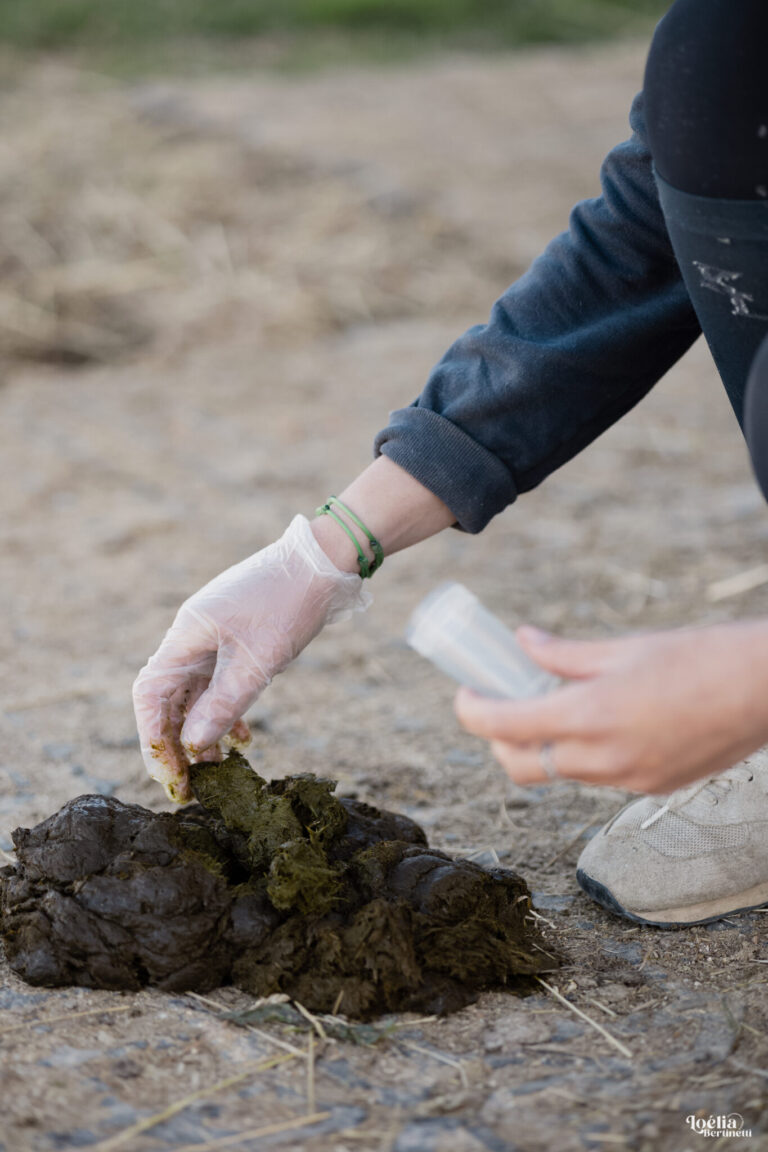
- Fresh lambs : ideally taken directly from the rectum of the horse (with a clean glove), or on the ground immediately after defecation. If the sample cannot be sent on the same day, store it in the refrigerator (4°C) for up to 24 hours. Beyond this, eggs may hatch or deteriorate, distorting results.
- Quantity A few dumplings of crottins are enough (ideally in the heart of the crottin), about 25 grams. No need to fill a whole bucket, a few spoonfuls well packed in the pot do business.
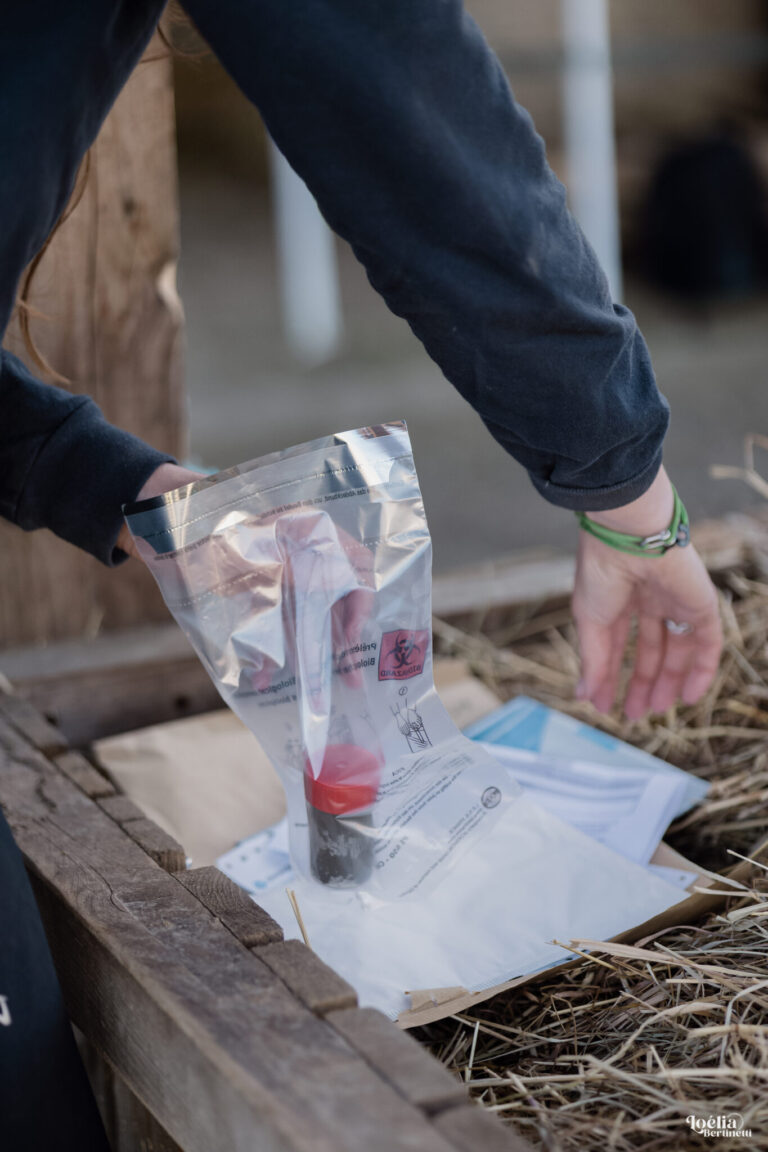
- Container : clean hermetic jar (sterilised jam jar type) or sample bag supplied in a coproscopy kit. The important thing is that the container is properly closed to avoid cross-contamination and leakage during transport.
- Identification Note the name of the horse, the date and time of collection on the pot or on a accompanying sheet. If you take several horses, clean your hands carefully and change the glove between each animal to avoid contamination.
Both options for coproscopy analysis
- Via an analytical laboratory : you bring the sample directly to an analytical laboratory (such as Eurofins or the Pastoral Alliance)
- Via a home kit You order a complete sampling kit that contains all the necessary equipment (sterile pot, transport bag, good Chronopost, information sheet). You do the sampling yourself, send the sample to the laboratory, and receive the results by email within a few days. This is the most convenient option for owners who themselves manage the parasitism of their horse.
Our coproscopy kit ESC Laboratory includes all the sampling equipment, the sending Chronopost 1pm to the EUROFINS laboratory, the complete analysis, and the detailed report by our partner veterinarian. The results will be communicated to you within 5 working days.
How to read the results of a coproscopy?
You have received your results, and you are wondering what these numbers mean. Here is how to interpret them in a clear and action-oriented way.
The OPG result: what it means
The result OPG (Eggs By Gramme) is the key figure of coproscopy. It indicates how many eggs of strongles were counted in a gram of crottin. This number allows you to classify your horse in a category and decide what to do.
OPG outcome | Status | Recommended decision |
< 200 OPG | Low excretor | No immediate treatment required unless specific context. The annual protocol remains to be adapted with the veterinarian according to the season, lifestyle and parasites. |
200 - 500 OPG | Moderate excretor | Treatment to be discussed with the veterinarian according to the context (season, general condition, living conditions). A new coproscopy 4 to 6 weeks later may be recommended to follow the evolution. |
> 500 OPG | Strong excretor | Recommended defrost treatment. These horses are the main contaminants of pastures and require regular follow-up (3 to 4 treatments per year). |
Important point The intervention threshold varies according to the protocols. Some consider that a horse becomes a real concern beyond 200 OPG, while others use 500 OPG as the decision-making threshold. Interpretation must always take into account the context. Discuss it with your veterinarian to adapt the threshold to the situation of your horse (living conditions, horse density in the meadow, parasitic history, etc.)
What coproscopy does not detect (limits to know)
Coproscopy is a powerful tool, but it has its limits. Knowing them is essential to correctly interpret the results and not to wrongly conclude that a horse is free of pests.
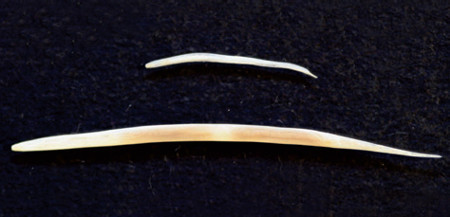
Source: ESCCAP France
- Oxides (Oxyuris equi) : these worms lay their eggs around the anus, not in the crottins. They adhere to the skin and cause intense itching at the base of the tail. To detect them, one must realize a Scotch-test : one applies a piece of adhesive tape around the anus, then one looks at the microscope. A negative coproscopy therefore does not exclude the presence of dioxyides.
- Enkystate larvae of small strongles During their development cycle, the cyatostom larvae may be s. enkyster in the intestinal wall and remain in hibernation for several months. These larvae do not lay eggs, so they are invisible to coproscopy. Their massive emergence in spring can cause severe digestive disorders (larval cyanostomosis), even in a horse whose coproscopy was negative a few weeks earlier.
- Tenias (Anoplocephala perfoliataCoproscopy detection is unreliable. Tenias do not lay continuously, and eggs are often absent from crottins even when the horse is infested. For a reliable diagnosis, a ELISA test (search for antibodies in blood or saliva) is recommended.
- Gastrophils These fly larvae are not excreted in the crottins in summer. They can be observed visually in winter-exit crottins (February-March), but coproscopy does not detect them.
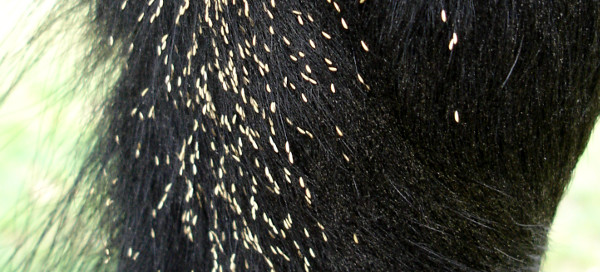
Fly Eggs – Source: ESCCAP France
The notion of "sentinal" horse
In a group of horses, it is not necessary to analyze all individuals to know the overall parasitic status. The principle of sentinel horse makes it possible to optimize monitoring.
In concrete terms, it is sufficient to analyse 3 to 4 representative horses herd (young, adult, elderly) to estimate overall parasitic pressure. If these sentinel horses are small excretors, the rest of the group is probably also. If one of them is a strong excretor, the other strong excretors of the group will have to be identified to treat them in a targeted manner.
This approach allows limit the number of analyses while maintaining a reliable view of the parasitic situation. Strong chronic excretors (the 20% of horses that house 80% of parasites) must be identified and monitored regularly.
How much does a coproscopy cost?
The cost of coproscopy varies depending on the method used and the provider chosen, but it remains generally very affordable.
- Testing via the veterinarian : between 15 and 45 € by the technique used. Simple qualitative coproscopy (presence/absence of parasites) usually costs 15-25 €. A quantitative coproscopy following the McMaster method (GGO accurate counting) costs 30 to 45 €.
- Home kit + laboratory : 37.50 € for our ESC Laboratory kit. This tariff includes the sampling equipment, the Chronopost shipment to the EUROFINS laboratory, the full analysis (qualitative and quantitative) and the detailed report by our veterinarian.
The cost of a coproscopy should be put into perspective : Coproscopy costs less than a quality demifuge (40 to 60) €), and much less thanparasitic colic whose treatment may exceed several hundred euro. It is an investment that helps avoid unnecessary treatments and preserve the health of your horse in the long term.
Discover our 37.50 coproscopy kit € → Simple sampling, results in 5 days, veterinary support included.
FAQ: Frequently asked questions about equine coproscopy
Can you do a coproscopy yourself without a veterinarian?
Yes, with a suitable coproscopy kit. The sampling is done at home independently, the analysis is carried out by an approved laboratory and the results are interpreted by a veterinarian. This option is perfect for owners who themselves manage the parasitic tracking of their horse.
My coproscopy is negative, is my horse really free of parasites?
Pas nécessairement. Un résultat négatif signifie qu’aucun œuf n’a été détecté dans l’échantillon analysé. Mais certains parasites ne sont pas détectables par coproscopie : larves enkystées de strongles, oxyures, gastérophiles. Une coproscopie négative ne garantit donc pas l’absence totale de parasites.
À quelle fréquence faire une coproscopie à son cheval ?
Au minimum une fois par an, idéalement en été (juin-août) lorsque la charge parasitaire est au pic. Les chevaux forts excréteurs peuvent nécessiter un suivi plus régulier, avec une coproscopie au printemps et une en été pour adapter les traitements. Les jeunes chevaux (moins de 3 ans) doivent être suivis plus fréquemment.
Peut-on faire une coproscopie sur plusieurs chevaux en même temps ?
Oui, et c’est même recommandé pour évaluer le statut parasitaire du troupeau. La notion de cheval sentinelle permet de limiter le nombre d’analyses : en testant 3 à 4 chevaux représentatifs, on obtient une vision fiable de la situation globale. Les chevaux identifiés comme forts excréteurs nécessitent ensuite un suivi individuel.
Conclusion
La coproscopie n’est pas un examen réservé aux élevages professionnels, c’est l’outil de base de tout propriétaire qui veut prendre soin de son cheval intelligemment. Elle coûte moins cher qu’un traitement inutile et donne une réponse concrète là où l’observation à l’œil nu ne peut rien dire. Fini les vermifugations à l’aveugle : vous savez désormais quand traiter, pourquoi le faire et avec quelle molécule. C’est ça, gérer le parasitisme de façon raisonnée.
Prêt à connaître le vrai statut parasitaire de votre cheval ? Commandez le kit coproscopie ESC Laboratoire