
Some horses have intense skin reactions during the warm season: repeated scratches, irritations, and increased insect sensitivity.
To act in the field, ESC Laboratory offers natural dietary supplements formulated for support skin balance from the inside.
They complement the action of topical care by strengthening the body's natural response to seasonal allergens.
-
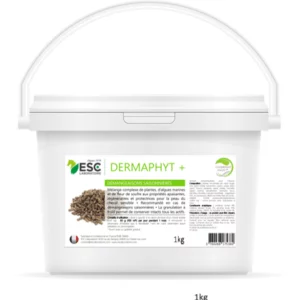
DERMAPHYT + Seasonal horse itching – Enriched herbal supplement
- 49,10 €
- Dermaphyt + is a complementary food made from a complex mixture of plants, seaweeds and sulphur flower. Dermaphyt + helps to calm seasonal itching in the horse. Production in cold and pressure-free granulation in order to respect the nutritional qualities of the first materials. Bucket 1 kg
- Choice of options

Understanding the mechanism of seasonal reactions in horses
Each spring, some horses develop hypersensitivity to culicoid bites, small hematophageal insects very present at dusk and dawn, particularly active near water points and wetlands. This allergic reaction causes intense itching, inflammation of the skin and discomfort that can last all summer, even worsen from one season to the next.
What is observed on the surface, repeated scratches, broken hairs, irritated skin, is the result of an immune mechanism that wraps up at each contact with allergens injected by insects. This is where food supplementation occurs: not to act on the surface, but to support the inside body, prepare the ground before exposure and reduce the intensity of allergic response.
Why acting from within changes the situation
An external care soothes symptoms in real time, it's its role. But he's not acting on the allergic field. A horse with a well prepared body will react less intensively to the bites, will need less scratching and will recover faster between two exposures.
The dietary supplements formulated for skin support act on several axes simultaneously:
- Support for the natural immune response to seasonal allergens
- Reinforced skin barrier to limit skin permeability to irritants
- Draining of toxins to help the body eliminate insect-inoculated substances
- Nervous soothing to reduce irritability and compulsive scraping behaviour
- Skin and skin nutrition to accelerate regeneration after lesions
When to start the cure: the key is anticipation
This is one of the most important and often overlooked points: a dietary supplement against seasonal skin reactions is not used in response to a crisis. It is used in prevention, before symptoms appear.
Our veterinarian's recommendation: Start the cure 4 to 6 weeks before the usual start of scrapings, usually as early as April in temperate regions, sometimes as early as March for highly sensitive horses or in areas with high culicoid density.
Starting early, the organism is gradually prepared to manage first contact with allergens. Horses with well-conducted preventive treatment usually have less intense symptoms, which settle down later in the season and disappear earlier in the fall.
Do not stop the cure too early: the culicoids remain active until October in many French regions. Continue the supplement until the first frost guarantees protection over the entire season at risk.
Food supplement and external care: a complementary approach
The question is not to choose between internal and external care, it is to combine them. Both approaches operate at different levels and are mutually reinforcing:
| Internal action | The dietary supplement prepares the immune field, supports the skin barrier and reduces the intensity of allergic reactions over time. |
| External action | The topical treatment (spray, balm, shampoo) immediately calms itching, protects exposed areas and accelerates healing of lesions. |
| In practice | Food supplement in continuous cure from March to October + external care on friction zones 1 to 2 times a day during periods of high insect activity. |
Which horse will benefit most from complementation?
All horses susceptible to seasonal itching Some profiles have a particular advantage:
- Horses that have already had summer itching in previous years: recidivism is almost systematic without preventive management
- Races recognized for their predisposition: ponies, Fjords, Islanders, Haflingers, Frisians, some Arabic purebreds.
- Horses living in the meadow, continuously exposed to insects, especially near water points
- Horses stressed or in a state of immune fatigue, more likely to react strongly
- Horses in spring food transition, a time when the organism is particularly sought after
Combining internal food supplements and targeted external care, this is to offer your horse complete protection — and during the crisis.
FAQ on seasonal itching in horses
Can a food supplement help a horse scratches because of the summer dermatitis?
Yes. Some dietary supplements act on the allergic field by supporting the natural immune response and reducing sensitivity to insect bites. They are particularly useful in preventive treatment, starting 4 to 6 weeks before the warm season.
What difference between a food supplement and an external care for the itching of the horse?
The dietary supplement acts from inside, on the immune system and skin terrain. The external care (spray, balm) soothes the skin directly. Both approaches are complementary: the supplement prevents and reduces the intensity of reactions, the external care relieves daily.
When in the year begin a food supplement cure against itching summer?
It is recommended to start the cure 4 to 6 weeks before the start of the beautiful season, from April in temperate regions. A fall transition cure can also help the body regulate itself.