

Myositis in the horse: understand and accompany a "blood stroke"
Myositis, often called « Bloodshed » or equine rhabdomyolysis, is one of those muscle phenomena that legitimately worries the owners of horses.
This is not a single, well-defined pathology, but rather a set of acute or recurrent muscle manifestations that can be significantly impact locomotion, work and well-being horse.
In this article, we share you:
- the main causes of myositis in horses,
- the signs to be observed,
- risk factors to be taken into account,
- prevention strategies to be implemented
- and natural and practical approaches to accompany the horse's body in these delicate situations.
What is exercise rhabdomyolysis (blood stroke) in horses?
The term « myositis » is often used imprecisely in the equine medium. It literally designates muscle inflammation, but in the common language, it is used to describe a set of acute muscle phenomena occurring either during exercise or after effort.
We talk indifferently about « Bloodshed », of « stress myositis », of « rhabdomyolysis on exercise », or « Monday's disease », the latter name referring to the frequent cases observed in horses returned to work abruptly after a full day of rest in the box.
The rhabdomyolysis etymologically corresponds to the destruction (lysis) of skeletal striated muscle fibres (rhabdo = striated, myo = muscle). This destruction releases myoglobin into the bloodstream, a protein that normally allows the transport and storage of oxygen in muscle cells. When released in large quantities, it is eliminated by the kidneys and colours urine in dark brown or black, a clinical sign characteristic of myositis in horses.
The main distinctions are:
- on acute criseswhich occur sporadically in horses without a particular history,
- and Recurrent forms, observed in genetically or metabolically predisposed horses.
Why do horses develop myosites? Causes and risk factors
Myositis is never the fruit of chance. They are the result of the combination of several factors which together create a favourable ground for the crisis.
Metabolic and energy imbalances
The first factor involved is often a gap between power supply and energy actually spent by the horse. A horse fed with a ration rich in starch and fast sugars, but working little or irregularly, can see its muscular energy metabolism disrupted. This rapid carbohydrate overload promotes intracellular imbalances, particularly in calcium and oxidative stress, which predisposes to crisis.
When he suddenly gets back to work, this energy overload creates a situation of metabolic tension. Muscle cells struggle to manage the available energy flow, which can trigger a chain reaction leading to fibre destruction.
Stress and rush of effort
Horse stress plays a central role in the appearance of myositis. He can be physical, but also nervous. An anxious, excitable or uncomfortable horse in his working environment has increased muscle tension that predisposes him to seizures.
Inadequate warming, too intense a session for the level of conditioning of the horse, or a recovery too brutal after several days of rest are all at risk. It is precisely for this reason that the « Monday's disease » wears that name.
The underlying myopathy (PSSM, RER)
Some horses have genetic or metabolic predispositions that make them particularly sensitive to rhabdomyolysis episodes. Two broad categories of myopathies are well identified:
- The MSSP (or polysaccharide storage myopathy) is a genetic anomaly that mainly affects certain breeds (Quarter Horse, Paint Horse, Appaloosa, certain lines of line horses). These horses abnormally accumulate glycogen in their muscles, which strongly predisposes them to seizures, even during moderate exercises. Their diet must be particularly adapted, with a sharp reduction in starch and sugar intakes.
- The RER (or rhabdomyolysis of recurrent effort) mainly affects English purebreds, trotters and certain mares of nervous breeds. It is related to a lack of regulation of calcium in muscle cells. These horses are particularly sensitive to stress and excitement, and their seizures occur frequently in emotionally charged situations.
Individual predisposition factors
Beyond genetic myopathies, several individual factors influence the sensitivity of a horse to myositis.
- Age is a primary risk factor. Young horses with a developing muscle system, and older horses with declining recovery capabilities, are two profiles that should be carefully monitored.
- The temperament also counts : An anxious, very reactive or nervous horse will tend to maintain high muscle tension even at rest, which weakens it.
- Finally, history of muscle disorders significantly increase the risk of recurrence.
Environmental and terrain factors that favour myositis
The environment in which the horse evolves directly influences its risk of developing a crisis. One insufficient hydration is a major risk factor: a dehydrated horse is a horse whose metabolic exchange is less effective and whose kidneys are more fragile to the elimination of myoglobin.
The electrolytic imbalances (especially sodium, potassium, calcium and magnesium) disrupt the functioning of muscle cells and nerve transmission. A horse that sweats a lot, works in hot weather, or does not have permanent access to a salt stone, can quickly end up in electrolytic deficit.
Finally, nature of the soil On which the horse works is important. A soil that is too hard overly demanding muscles and tendons. On the other hand, too much ground requires greater propulsion effort. In both cases, the muscle load is increased and the risk of crisis increases.
How to recognize a myositis attack in the horse?
Watching your horse with attention, knowing its usual reactions, and know how to spot myosite signals are the keys to early detection.
How muscles react in times of crisis
Muscle fibers are highly specialized cells that function through constant exchanges of calcium, d-ATP (cell energy currency), and oxygen. Whena crisis of myositis, these exchanges are brutally deregulated : calcium accumulates anarchically in cells, fibres contract in an uncontrolled manner and eventually destroy.
This destruction frees in the circulation of muscle enzymes :
- creatine kinase (CK)
- and aspartate aminotransferase (AST).
These are the enzymes that the veterinarian will dose in the blood for confirm myositis crisis and assess its severity.
These biological markers are valuable indicators, but they are only accessible to the veterinarian. What matters to the owner is that know how to observe clinical signs which precede or accompany this cellular reaction.
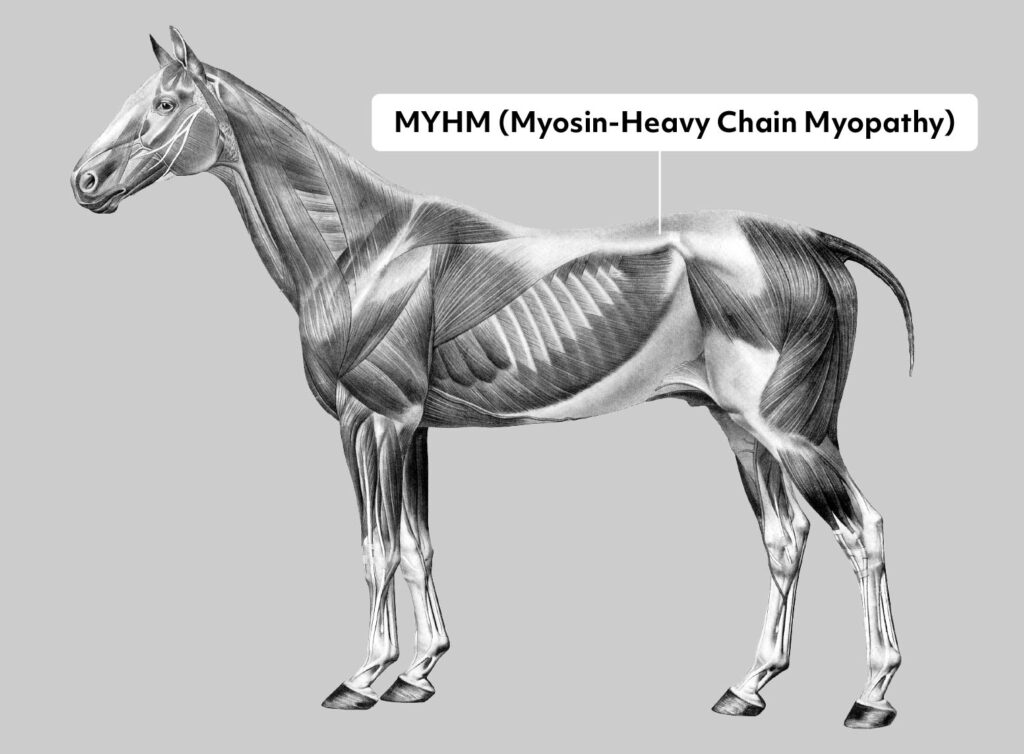
Source: Equine Genetics
Typical muscle signs
When a crisis starts, the signs can be subtle at first and then worsen very quickly. The horse begins by shortening its stride, be reluctant to move forward and manifest a sudden stiffness.
If effort continues, the signs increase:
- the horse starts sweating abundantly, even if the effort was not intense,
- His breathing becomes rapid and superficial,
- and it can eventually simmer completely, unable to take one more step.
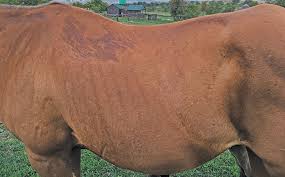
- The muscles of the rump, back and sometimes shoulders become hard to palpation,
- and the horse shows a keen sensitivity to the touch.
In the most severe cases, the horse may lie down and be unable to rise, tremble with his whole body, or adopt a posture reminiscent of that of the colic. It is at this stage that urine may take dark coloration, sign that myoglobin is massively released into circulation.
Differentiating myositis from other discomforts
Not all horses with unusual stiffness or fatigue necessarily have myositis. The difference lies in the intensity and the rapid appearance of signs. Mild muscle curvature usually improves with movement and gradually disappears. Myositis, on the contrary, worsens if the horse is forced to move, and the signs are often more dramatic.
The associated behavioural signals
Beyond objective muscle signs of myositis, the behaviour of the horse in crisis changes significantly. He refuses to move forward, can be agitated, nervous, irritable, or on the contrary abnormally shot down. His resting posture is changed: some horses camp from the front or the back to relieve their painful muscles, others remain motionless, the limbs stiff.
Increased sensitivity to touch is common in myositis in horses. Putting your hand on the rump or back can trigger a sharp reaction. The horse can also manifest signs of widespread stress: ears back, dilated noses, anxious look...
Diagnosis of horse myositis: the role of the veterinarian
Faced with suspicion of myositis, the reflex must be to call the veterinarian without delay. He performs a full clinical examination and then takes a blood sample to dose the muscle enzymes (CK and AST).
The veterinarian is also there to exclude other causes: a mechanical lameness, a colic, a beginner forbure, or a joint problem may sometimes mimic some signs of myositis. His expertise is essential to make the right diagnosis and implement appropriate care.
When do I call his vet in an emergency?
Some signs must trigger an immediate veterinary call, without waiting:
- Dark urine (brown, red or black): sign of massive release of myoglobin, with risk of renal failure.
- Total inability to move : the horse is blocked, lying and cannot rise, or standing but frozen.
- Signs of intense distress Profuse sweating, very high heart rate (greater than 80 bpm at rest), generalized tremors.
- Signs of severe colic : anxious look, round back, scratching the ground, restlessness.
In these situations, Don't move the horse. Any attempt to make it work worsens muscle destruction. Leave him in place, put water at his disposal, cover him if necessary to keep his muscles warm, and wait until the veterinarian arrives.
Accompany a horse subject to myosites
Management of a horse with myosite episodes is based on a comprehensive and progressive approach. The aim is not simply to return to work, but to accompany the body on a sustainable basis to limit recidivism.
Resuming work gradually after myositis
After a crisis, the recovery must be gradual. A long and complete warm-up (15 to 20 minutes of active walking with progressive transitions) is essential to prepare the muscles.
Better focus on regular and moderate sessions (several days a week) rather than strenuous effort. Transitions must remain fluid and return to calm include at least 10 minutes walk to promote muscle relaxation.
Fostering movement on a daily basis
Free movement plays a key role in the prevention of myositis (which is also one of the main causes of myositis). 3F of the horse, essential to its well-being). A horse living mainly in the box, with intense punctual work, is more at risk. LDaily access to the paddock, ideally with various soils, promotes spontaneous activity that maintains blood circulation, supports the elimination of metabolic waste and maintains muscle flexibility.
Hydration and recovery
Constant hydration is essential for good muscle function. Water shall be permanently available. In hot weather or after sustained effort, suitable electrolytes may help compensate for mineral losses.
Rest must remain active : paddock exits, walking in hand, gentle mobilization. Improvement is measured gradually (return from relaxed behaviour, fluid mobility, loss of muscle sensitivity) before considering a complete recovery, always with caution.
Food and supplements to support the muscle balance of the horse
Feeding plays a central role in prevention of myositis and in accompanying sensitive horses.
Key nutrients to monitor
- The essential proteins and amino acids (lysine, methionine, threonine) are essential for muscle building and repair. These include alfalfa, extruded soybeans or flaxseeds.
- The duo vitamin E – selenium plays a major antioxidant role. These nutrients are essential for the horse because they protect muscle cells from oxidative stress due to exercise. Since stored hay rations are often low in vitamin E, supplementation may be relevant in working or sensitive horses. In sensitive horses, vitamin intake Natural E (alpha-tocopherol) is particularly important when access to fresh grass is limited, as is often the case for horses fed mainly to stored hay.
- Lenergy must come mostly from fibres and lipids, limiting starch and fast sugars, especially in predisposed horses (PSSM).
- Finally, the magnesium supports muscle relaxation and nervous balance.
Our dietary supplements to support muscle recovery
At ESC Laboratory, several natural solutions are formulated to support horses at work or with muscle sensitivity.
- The MSM, source of bioavailable organic sulfur, participates in the structure of collagen, essential component of muscles, tendons and joints. It accompanies the integrity of musculoskeletal tissue and easily integrates into the daily ration. It is also known for its action on joint and muscle comfort, especially during periods of recovery after effort.
- Equiprotemix provides quality proteins (such as fenugrec), key trace elements (magnesium, zinc, selenium) and a vitamin complex to support the development, recovery and maintenance of muscle mass, especially in the back-up or senior horse.
- Myopulse is an antioxidant concentrate that combines vitamin E, selenium, SOD, amino acids and magnesium to accompany effort and recovery during periods of sustained work.
Each supplement is used in a targeted manner, with a progressive introduction to respect the digestive balance of the horse.

FAQ – Myosites in the Horse
Can a horse continue to work after myositis?
Yes, in most cases, a horse with an episode of myositis may return to work after a suitable rest and recovery period. The key is the progressivity of re-conditioning and the adjustment of food and the environment to avoid recurrence.
How to adapt training to reduce the risk of myositis?
Prioritise regularity (moderate work 5 days a week rather than intense 2 days), observe a minimum warm-up of 15 to 20 minutes, vary the exercises and looks, and systematically integrate a phase of calmness at the end of the session.
Can diet influence the risk of myositis?
Absolutely. A diet that is too rich in starch and fast sugars, especially in an irregular or predisposed horse, significantly increases the risk of myositis. Priority should be given to quality fibers, fats and low energy sources, while ensuring quality vitamin E, selenium, magnesium and protein intakes.
Can myositis go unnoticed in the horse?
Yes, there are subclinical forms of myositis where the signs are discreet: slight shortening of the stride, somewhat slower recovery after exercise, moderate muscle sensitivity. These forms often go unnoticed but may indicate a fragile terrain that deserves your attention.
Can myositis become recurrent in some horses?
Yes, some horses have genetic predispositions (MSPS, RER) or metabolic terrain that makes them sensitive to repeated episodes of myositis. These horses require very rigorous food management and monitoring throughout their sporting life.
Can stress promote the appearance of myositis?
Yes, stress, whether physical or psychological, plays a major role in triggering crises. Nervous or highly reactive horses are statistically more exposed, particularly in the ER.
Myositis in horses is a multifactorial muscle phenomenon that is not simply an exercise incident. Whether it occurs on an ad hoc basis or is linked to genetic predisposition, it requires a comprehensive and coherent approach over the long term. It is the combination of an adapted diet, gradual management of work, a favourable environment and careful observation that helps to limit recurrences and provide long-term support for sensitive horses. To support your horse on a daily basis, discover the natural ESC Laboratory supplements, formulated to accompany muscle recovery and the body's general balance.