You certainly already know clay, this natural sedimentary rock that is extracted from the soil. But did you know that she owns many particularly interesting virtues for the health of the horse?
Rich in crystals, which will form in superimposed layers, clay offers riders a natural remedy against many evils that affect their horses. Focus on its properties, the most frequent use of clay for horses, as well as our advice to fully enjoy its benefits.
What is clay and why is it interesting for horses?
The clay, whatever its colour, is a sedimentary rock that is extracted from the soil. It is precisely because it comes from it that it contains many compounds. In particular small crystals with an ultra complex structure which form layers stacked together, a little like a thousand sheets.
This structure has 2 advantages. The first is precisely to build ionic compounds that give it many natural virtues. The second is that this thousand leaves facilitate swelling when clay comes into contact with water.
Beyond its structure, clay also has a particular color, which varies from white to green, passing through pink. These variations are due to the iron concentration and its degree of oxidation (which evolves over time). We know better the green clay because it is the one that offers the most interesting care properties... But we'll come back later.
What are the properties of clay for horses?
As has already been mentioned above, clay has to its medicinal properties to its mill-leaf structure. In particular, the latter confers on it powers to:
- Absorption. L’argile pour les chevaux a pour principale particularité d’absorber les liquides, un peu comme une éponge. Et, dans le cas qui nous intéresse, les sécrétions produites par une plaie ou des liquides inflammatoires intra-tissulaires (au niveau des muscles ou des tendons, par exemple). Elle agit également dans le système digestif en absorbant les excès de liquide afin de Restore good digestion in the horse.
- Adsorption. L’argile a aussi un pouvoir d’adsorption dans le sens où elle va retenir à sa surface toutes les toxines et les microbes avec lesquels elle entre en contact. C’est donc un excellent antibactérien naturel.
- Astringent. It tightens the tissues and can therefore be applied to accelerate tendon recovery or joints after intense effort. For example, clay is used for congesting cases, most often applied as a filler.
- Cicator. Some types of clay for horses also have the peculiarity of stimulating blood clotting. But also to promote healing due to a good concentration of aluminium silicate.
- Covering. Used as an intestinal dressing, horse clay protects the mucous membrane of the stomach from aggressions of any kind (excess gastric juice, acid, microbe or biliary salt). It is therefore of great help in preventing ulcers and preventing microbes and toxins from passing from the intestines to the bloodstream.
When to use clay for horses?
So the clay for horses has many benefits. It can be used in different cases to treat or prevent several conditions, including:
- Argile pour les tendons : accélérer la récupération des articulations et tendons du cheval après un effort ou une blessure) ;
- Argile contre l’engorgement : désengorger les membres du cheval de manière préventive (pas plus de deux à trois fois par semaine) ou après le travail ;
- relieve the horse after a trauma (such as a hematoma, a stroke or a bruise);
sooth the lesions caused by a summer dermatitis ; - limit inflammation of the superos.
- Assainir les fourchettes avec une argile pour la fourchette spécifique.
Attention, however, to do not use it for anything and anything. Dans leur grande majorité, les argiles pour chevaux ne peuvent par exemple pas s’appliquer sur les plaies ouvertes, car leurs composants peuvent avoir un effet irritant. Seule l’argile verte pure pourra être utilisée.
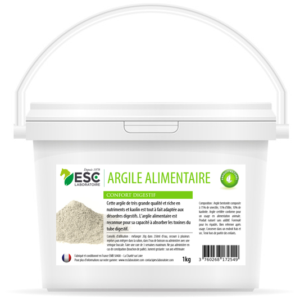
L’argile peut être utilisée en interne, avec de l’argile alimentaire pour les chevaux. En cas de trouble digestif notamment, on peut ajouter de la poudre d’argile alimentaire, mélangée avec de l’eau, à la ration du cheval.
What kind of clay do you prefer to treat a horse?
On en vient à la question fatidique : quelle argile pour cheval devez-vous utiliser ?
Indeed, there are several types:
- Green clay, which is by far the most popular among riders. It helps to relieve the congestion of the members of the horses, relax their tendons and eliminate the toxins that have accumulated. Green clay is also effective to avoid rollers.
- Antiphlogistin. It is a variant of green clay in which components have been added (primarily from the arnica and the aloe vera). However, it cannot be used in some cases as it contains menthol, with heating effects. If the horse has a sharp wound, it's better to avoid it.
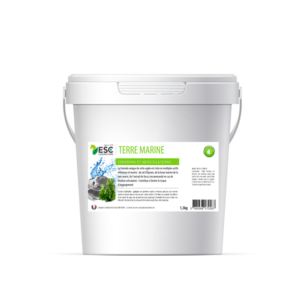
- Marine clay. It has draining properties, restructuring, firming and decongestant).
- Oral clay. Elle présente des vertus intéressantes sur le plan digestif comme on l’a vu. Elle permet notamment de soigner les inflammations de la paroi intestinale et les gastralgies. Vous pourrez l’utiliser en cas de diarrhée chez un poulain ou pour les chevaux présentant des ulcères.
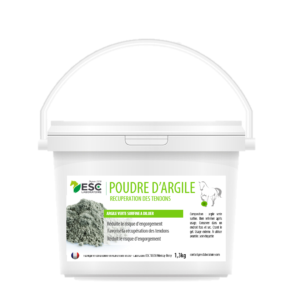
Green clay is therefore the most commonly used in the world of horses. At ESC Lab, we developed a powder from green clay from deposits in the Auvergne Volcano region. This provenance guarantees exceptional qualities to this nutrient-rich clay. It will be particularly effective in tightening tissues and in reducing congestion.
Which clay ESC Laboratory choose?
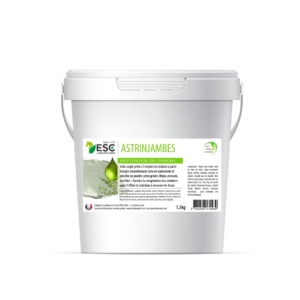
With over 30 years of experience in clay-based products applied to comfort care for horses, our company now offers a wide range of clays and clay-based products, including the Dead Sea Mud Marine Earth and the Earth clay-based Astrinjambes enriched with essential oils. So, which choice and for what use? These two types of clay (terrestrial clay and dead sea mud) both offer considerable benefits to horses, but have significant differences in origin, composition and properties. Let's look more closely at the distinctive features of terrestrial green clay and Dead Sea mud.
Origin and Composition:
Green Clay Earth:
Earth's green clay is extracted from quarries located mainly in France. Composed of minerals such as montmorillonite, kaolinite, and lillite, it owes its green colour to the presence of iron, silica, magnesium and calcium. This unique combination of minerals gives green clay purifying and regenerative properties.
Dead Sea Boue:
The mud of the Dead Sea, for its part, is extracted from the shores of the Dead Sea between Israel and Jordan. This mud is rich in minerals such as magnesium, calcium, potassium and sodium. Its unique composition makes it a popular ingredient for its therapeutic properties. Dead Sea mud is known to help relieve skin conditions such as psoriasis and eczema.
Benefits and properties for the horse:
Green Clay Earth:
The earth's green clay, rich in minerals such as montmorillonite, kaolinite and lillite, acts as a natural stimulant for blood and lymphatic circulation. It is therefore recommended to facilitate the recovery of tendons because of the following properties:
- Mobile Exchange Activation: Thanks to its ability to remove dead cells from the skin, green clay stimulates cell renewal, thereby promoting more effective lymphatic circulation.
- Toning of Capillaries: Minerals in green clay help strengthen the walls of blood vessels, thus improving the tonicity of capillaries.
The Dead Sea Boue:
For its part, the Dead Sea mud, famous for its wealth of beneficial minerals, offers significant benefits for muscle recovery after physical exercise due to its magnesium content, an essential mineral for muscle relaxation. It will therefore contribute to
- Relieving Curvatures: Minerals such as potassium and calcium in the mud help reduce inflammation, relieve post-training sterns and facilitate faster recovery
- Stimulating Sanguine Traffic: Applying the Dead Sea mud promotes better blood circulation, bringing more oxygen and nutrients to tired muscles to speed up the recovery process.
Comment utiliser l’argile en externe pour soigner son cheval ?
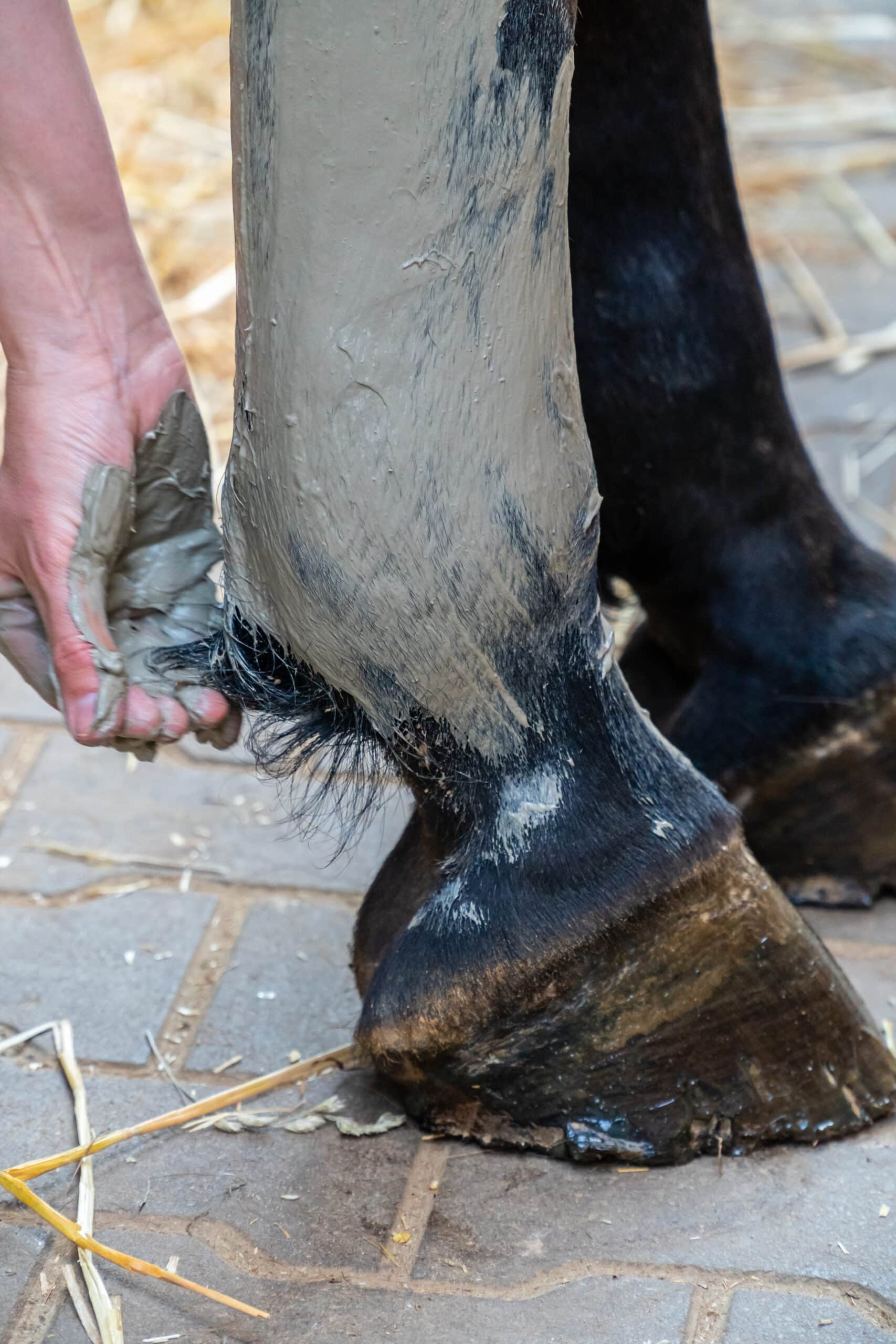
The first way you can use clay for horses is make it a plaster. Simply mix the powder with water. It is usually advisable to let clay powder absorb the liquid for 15 minutes to 1 hour before starting to mix. You will get a dough that is both smoother, but also much easier to apply.
Small advice that is very important at this stage: Avoid mixing your clay with a metalware or plastic. It could indeed disrupt the crystalline ionic structure of your plaster.
Then we move on to the application. Étalez votre emplâtre d’argile en couche épaisse and brush back on the limbs or body area of your horse to be treated. The ideal is to apply it as close as possible to the skin, then smooth it in the direction of the hair.
You can let the clay for horses act in the air, or coat in gauze, cellophane or newspaper before covering with rest strips. This will, in particular, help to conserve the moisture of clay and thus boost its action. Once it's done, you can rinse it with a good water jet and a brush.
Attention à ne pas réutiliser votre argile pour chevaux deux fois. En effet, elle aura absorbé des substances toxiques (sécrétions, liquides et autres impuretés) et vous risquez donc d’en infecter votre cheval.
-
3 reviews
- Out of stock
MARINE LAND – Horse clay enriched with marine minerals – Loan for employment
- 50,90 € TTC
- Read more
-
-
43 reviews
ASTRINJAMBES – Clay enriched with essential oils – Recovery and congestion tendons
- Price range: 24,60 € at 53.30 €
- Choice of options
-
28 reviews
GREEN DARGILE POWDER – To be reconstructed – Horse tendons recovery
- Price range : 13,40 € at 46.60 €
- Choice of options