
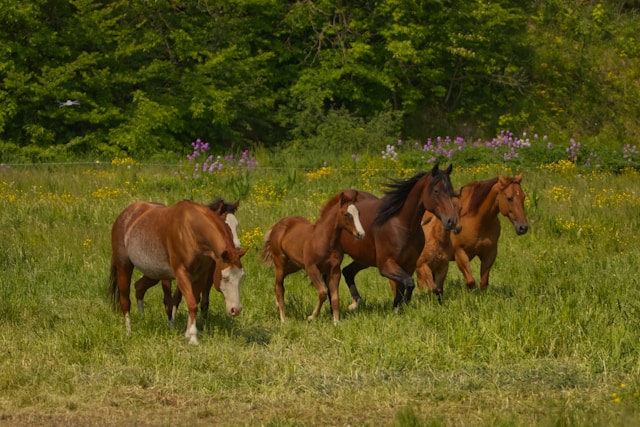
The « 3F » ; Friends, Forage, Freedomhave become the mantra of equine well-being. To be healthy, both physically and mentally, horses need to:
- their congeners,
- quality feed (and at will)
- and freedom of movement.
These three pillars would therefore constitute the indispensable basis for a serene and fit horse. All too often, however, these principles are applied superficially: poor quality hay, tight paddock and poor socialization with other horses. Not to mention that respect 3F is not enough to meet the real individual needs of your horse.
In this article, we explore every "F" in depth, their limits are highlighted and, above all, you are given concrete advice to make them real levers of well-being in order to offer what is best for your horse.
What does 3F really mean for horses?
The "3F" — Friends, Forage, Freedom — are often presented as the basis of horse welfare. But before using them as a reference, it is essential to understand what they really cover.
Each corresponds to a need deeply rooted in the nature of the horse and it is by respecting them in their true sense that one can really improve his daily life.
Friends: the basic need for congeners
Horse is a social animal who needs contact with his peers to feel safe and serene. Interactions (whether through grooming, games or group trips) contribute to its emotional stability and calm down.
Conversely, total or even partial isolation can generate tensionsfrustration or inappropriate behaviour. Living alongside other horses in a harmonious way is therefore an essential pillar for its overall well-being.
Drilling: the central role of forage in horse welfare
The digestive system of the horse is made for using fibres continuously and in small quantities throughout the day. Forage is therefore not only a food: it is a central element for its digestive balance, serenity and emotional regulation.
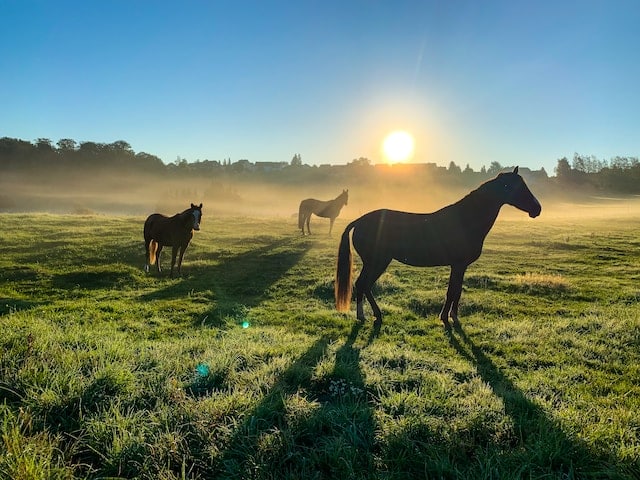
Appropriate management of fodder directly influences his health but also regulates stress and reduces the risk of digestive diseases (such as gastric ulcers in horses) and inappropriate behaviour.
Freedom: the need for movement and freedom
In nature, a horse moves between 15 and 20 km a day. Movement is therefore not a simple "plus", it is a vital need: it supports muscle function, joint flexibility, mental balance and digestive transit. Offering freedom of movement to his animal (in a paddock, in the meadow, with daily outings and varied movements) thus allows the horse to maintain this natural behavior and to remain in full shape, both physically and mentally.
Watch out because freedom is not just about being able to move: It also means being able to choose. Offering the horse several forage options, various distribution methods or different outdoor spaces allows it to express its preferences and adjust its activity according to its needs. As a group, he also chooses his game, rest or grooming partners. This freedom of decision, often overlooked by the masters, plays an essential role in its overall well-being.
Why is the 3F not enough to guarantee the well-being of a horse?
Offering the 3F to your horse can give the impression of having checked all the boxes... and yet, it happens that some people continue to show signs of stress, lack energy or have behaviors that question. It's normal: the 3Fs are a excellent base, but they must be adjusted to each horse to actually bear their fruit.
- Too poor forage, too rich or scarcely appetizing can create digestive discomfort or boredom.
- A group that seems harmonious can Hide tensions: a horse left out, a dominant one too present, limited access to hay.
- And "freedom" can remain very relative if the environment of your horse lacks variety or natural stimulants.
That's why observation remains the most valuable tool for real improving the well-being of the cheval. Analyze how he eats, rests, interacts or moves. This will allow you to adjust the 3Fs so that they really impact his health, according to his needs and temperament.
How can we improve the well-being of the horse, beyond the 3F?
Now that we know that the 3Fs are an essential base, it is time to use as real tools to improve your horse's daily life. It is not enough to check the boxes "Friends, Forage, Freedom" : the objective is to adapt each F to its temperament, age, discipline and specific needs.
Here we offer you concrete solutions so that the social bond, the quality of fodder and freedom of movement become real levers of comfort and serenity for your companion.
Optimize social life (Friends)
The social bond is essential, but not all horses get along in the same way. To form a harmonious group, consider age, temperament and affinity. Introductions should also be progressive :
- start with visual contact,
- then allow exchanges to the paddock,
- before moving on to a more complete herd life.
For more reserved or socially "difficult" horses, there are several solutions. For example, a stable duo with a compatible companion, a shared paddock to reduce tension, or a nose-to-nose contact allow to maintain the link without generating stress.
Really adapt the forage to the needs of its horse
Forage is not just food, it is the heart of the digestive comfort and well-being of your horse. Analyze hay allows to know its nutritional quality, its energy intake, its protein and mineral content and to adjust the ration according to the age, discipline and temperament of the horse.
The dietary supplements (such as VMCs) may, as their name indicates, supplement these contributions. Think also of water and the saltstone, which must remain permanently accessible, without restriction. Feed should also be distributed in such a way as to encourage consumption time and avoid boredom. For example, you can use different types of presentation or supports (such as hay nets suspended at different heights, feeders on the ground to vary positions, etc.).
Promoting Freedom of Movement (Freedom)
Freedom is not just about opening a paddock: it is about stimulate natural locomotion And your horse's curiosity. For example:
- aIncrease the surface available,
- vary soil
- but also introduce reliefs, trunks or paths to promote a more complete movement and strengthen muscles and joints of your horse.
The environment can be arranged to give more meaning to horse freedom. Add objects to explore, various herbs, different routes or secure rest areas. These arrangements will allow you to stimulate its curiosity, reduce stressbut also to give him the opportunity to choose his movements and interactions.
What about the sports horses? Respect the 3F... and work!
Sports horses have the same needs as their counterparts. The 3F (Friends, Drilling and Freedom) remain essential to their well-being. It is therefore not enough to train them: their daily lives must include socialization times, constant access to suitable fodder and periods of freedom so that they can move and become numb.
In a sports stable, maintaining these three pillars requires some adjustments. Horses subjected to intensive work may benefit from regular group release times, even short, to preserve their social interactions. The stress management is also crucial. The key is:
- Soft transitions between activities. Gradually introduce horses to group sessions or changes. For example, start with calm interactions in the loin or duo before more intense work.
- Enough rest time. Take appropriate breaks between sessions to allow the horse to recover mentally and physically.
- Various surfaces in the paddock. Offer different textures and reliefs (grass, sand, slightly inclined paths) to encourage natural movements and strengthen the muscles of your horse.
Finally, their ration must be adapted to energy density required by the work . A quality feed, supplemented if necessary and free access water will allow you to maintain its well-being despite the effort.
FAQ – The 3Fs and the well-being of the horse
Are 3Fs compatible with a horse living mostly in box?
Yes, the 3F of the horse can apply in box if space is suitable, with regular access to the paddock, forage available and interactions with other horses. The key is to complete life in box with daily physical and social stimulations.
Can the need for « Friends » with limited interactions?
Limited contact may partially meet social needs, but horses remain herd animals. Regular nose-to-nose contacts, shared paddocks or stable duos help strengthen the well-being of the horse.
Can mounted work compensate for a lack of freedom?
Mounted work does not replace natural freedom of movement. The 3F of the horse include the "Freedom" pillar because the animal needs to choose its movements and explore its environment.
Forage at will... even for horses that grow fast?
Yes, but it is necessary to adapt the type of fodder and eventually supplement with less energetic fibers. The objective is to respect the grazing behaviour of the horse while avoiding excessive weight gain.
How to measure the real impact of 3Fs on the well-being of your horse?
Observe his behaviour, sociability, attitude to rest and physical health. A serene horse, active, curious and in good physical condition is the sign that the 3F are correctly applied.
Can a horse alone but stimulated be happy?
The horse can be busy and active, but the absence of congeners limits its emotional balance. The 3Fs show that the social bond is as crucial as forage or freedom.
What difference in 3F application in an active or team stable and paddock paradise?
Each system enhances the 3F in its own way. The active stable mainly optimizes movement through free movement and vending machines. The paddock paradise is set on challenging and varied paths to encourage exploration. The team also favours fine interaction management and social security. The essential is to choose the configuration that best suits your horse's needs.
Really prioritize the 3Fs for your horse
The 3Fs are an excellent starting point, But their impact depends on their adaptation to each horse. To transform these principles into real well-being, we invite you to:
- Observe specific indicators : rate of ingestion, social interactions, posture at rest, signs of tension or boredom.
- Adjust forage in a targeted manner : quantity, quality, method of distribution and hay analysis if necessary.
- Optimizing the social framework : check fair access to hay and water, adjust groups, pair with a suitable companion.
- Valorizing the movement on a daily basis : vary the soil, enlarge the areas of displacement or add points of interest to encourage natural activity.
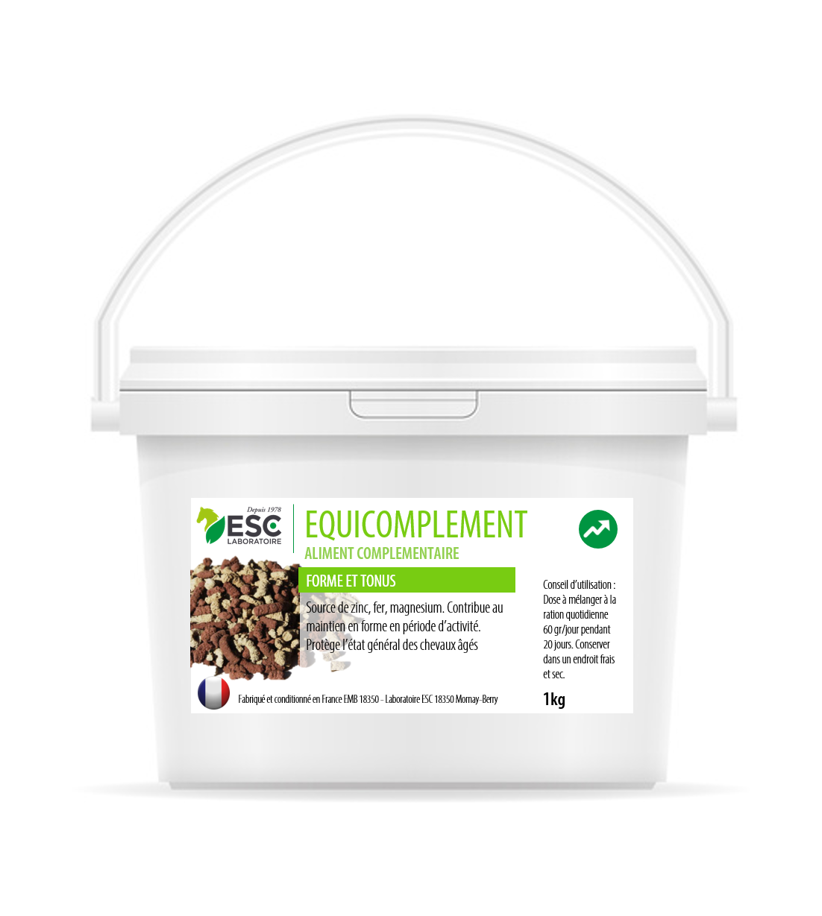
To support this overall approach, ESC proposes 100 % natural supplements, thought to strengthen the energy and vitality of your horse. Discover Equipment, a mineral and vitamin supplement (CMV) enriched with plant extracts to compensate for the deficiencies of your horse's basic ration.