
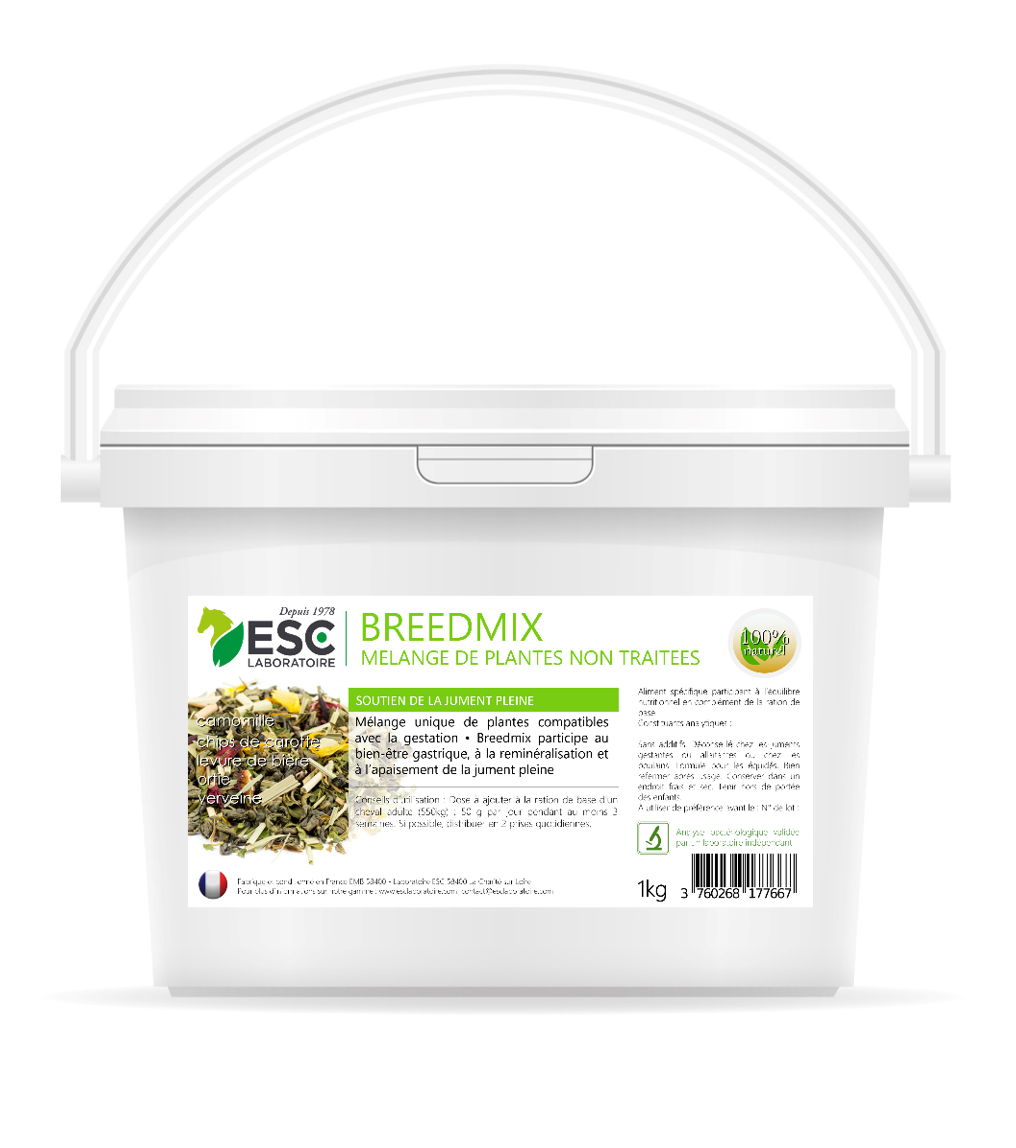



BREEDMIX – Well-being gestation and lactation mare – Mixture of plants
The initial price was: 41.90 €.31,43 €The current price is: 31.43 €. TTC41,90 €31,43 € /kg
198 in stock
Unique mix of plants, nutrient sources and participating in the well-being of the pregnant or lactating mare.
Quality analysis certified by an independent laboratory
Bucket 1 kg
What are the nutritional needs of the pregnant and lactating mare?
Pregnancy and breastfeeding are two particularly demanding periods for the mare's body. Its nutritional needs are changing to accompany the development of foal, milk production and maintenance of body condition.
A balanced diet, adapted to each stage of reproduction, is therefore essential to cover the needs of the girl child while preserving her shape and vitality.
Pregnancy: needs that are gradually increasing
The gestation of the mare lasts about 11 months. In the first few months, its nutritional needs remain relatively close to those of a maintenance mare. They then gradually increase, especially during the last three months of gestation, during which time the growth of the fetus accelerates.
Several nutrients then play an essential role:
- Essential proteins and amino acids: necessary for the development of foal tissue and the maintenance of mare muscle mass.
- Energy: the intakes must be adapted to the changing needs and body condition of the chick.
- Calcium and phosphorus: essential for the formation and mineralization of the foal skeleton.
- Copper, zinc and selenium: trace elements important for foal development and proper functioning of the organism.
- Vitamins A, D and E: involved in many physiological functions, including growth, bone metabolism and antioxidant protection.
Breastfeeding: a period of high nutritional needs
After pelching, milk production results in a significant increase in the nutritional needs of the mare, especially during the first months of lactation.
To support this period, it is essential to ensure that sufficient energy, quality protein, minerals and vitamins.
Body condition monitoring is also important: a lactating mare can mobilize its reserves to ensure its milk production when its ration does not adequately cover its needs.
How to accompany mare during pregnancy and breastfeeding?
Some good practices make it possible to adapt the feeding of the girl child to changing needs:
- Focus on quality forage: it forms the basis for feeding and must be distributed in suitable quantity.
- Gradually adapt the ration: energy and protein intakes must evolve according to the stage of gestation or lactation and body state.
- Ensure mineral and vitamin balance: intakes must be adapted to the specific needs of reproduction, without excess or deficiency.
- Regularly monitor body condition: to adjust the quantities distributed and to limit significant weight variations.
- Ensure adequate hydration: permanent access to clean and fresh water is essential, especially during breastfeeding.
Breedmix: a natural support for the pregnant and lactating mare
Specially formulated to accompany the chickens, Breedmix ESC Laboratory combines a selection of naturally sourced plants to support the well-being and vitality of the mare during pregnancy and breastfeeding.
It accompanies the mare during these periods when its nutritional needs evolve, while integrating into a balanced diet adapted to its physiological stage.
Breedmix thus constitutes a additional plant supportwithout replacing a balanced ration or mineral and vitamin supplementation adapted to the needs of reproduction.
Additional feed for horses.
Composition: beer yeast, lithothamne, chia seeds, precooked flax seeds, nettle,
Thistle-marry, verveine. No additives.
Instructions for use: dose to be added to the basic ration of an adult horse (550kg): 50 g per day for at least 3 weeks. If possible, distribute in 2 daily doses. To be renewed if necessary.
Adapt the dose to the weight and needs of the horse. 2 to 3 weeks may be necessary for proper assimilation of plants by the organism. The dose may be reduced after 3 weeks of supplementation if horse evolution permits. If possible and in case of prolonged treatment, a break of 10 to 15 days every 3 months is recommended. Do not hesitate to ask your veterinarian for advice before use or extension.
Precautions for use: Formulated for equidae. Close well after use. Store in a cool and dry place. Keep out of the reach of children.
Anti-Doping Control: This product may contain natural contaminants that can make an anti-doping test positive, and we recommend that it be discontinued before an official test. Ask a veterinarian for advice on waiting time (usually 72 hours).
Phytmix products are exclusive formulas.
The packaging is carried out in France by our Laboratory.
Each plant lot is approved by an independent laboratory that certifies its quality and analyses the bacteriological content.